
Home Composting Guide: Vol. 2
Dialogue with the Invisible World
"How to Read the Soil: What You Feed is What You Get"
You watched kitchen scraps disappear into dark, fragrant earth.
Something shifted in you – quietly, permanently.
Now you’ve noticed something deeper.
You’re not doing this alone.
What the Caveman Knew About Composting and Natural Cycles
CAVEMAN Says:
“When I buried scraps in the earth, I wasn’t doing the work. I was just showing up. The real workers? Invisible. Billions of them. They’ve been running this planet since long before I arrived. I just learned not to get in their way.”
Beneath your compost bin, trillions of microbes are at work right now. They’ve been building soil, feeding forests, and cycling nutrients through every living thing for billions of years – long before the first human walked the earth.
They don’t ask for much… But they do ask for one thing: “Don’t poison us.”
The Critical Choice Nobody Talks About
Modern life is full of invisible contamination:
- Pesticide residues on conventional produce
- Chlorine bleaching in paper products
- Synthetic surfactants in dish soaps
- Microplastics in “compostable” packaging
When these enter your compost, your microbial allies don’t just slow down.
They die.
The cycle breaks. The soil you’re building becomes a slow-burn poison. The vegetables you grow absorb it. And the ancient loop – the one that sustained humanity for 10,000 years – quietly collapses in your kitchen.
This is why what you put in matters as much as the composting system itself.
What Clean Composting Actually Looks Like
The CAVEMAN didn’t have certification labels. He had instinct and just KISS – Keep It Simple, Stupid: if it came from nature, it belonged back in nature.
We’ve lost that instinct. So here’s a practical translation:
✅ Compost-safe materials:
- Organic vegetable and fruit peels
- Unbleached coffee filters
- Chemical-free paper products
- Food scraps rinsed with natural soap
- Dry leaves, untreated cardboard
- Natural fiber materials (cotton, wool, hemp)
❌ Keep these out:
- Conventionally grown produce with heavy pesticide residue
- Bleached or glossy paper
- Synthetic-fragrance products
- Anything with plastic coating
The Clean Materials That Make the Difference
Disclosure: Some links below are affiliate links – I earn a small commission if you purchase, at no extra cost to you. I only recommend products I’ve personally used.
Read our full affiliate disclosure here.
The Clean Materials:
Composting Accelerators:
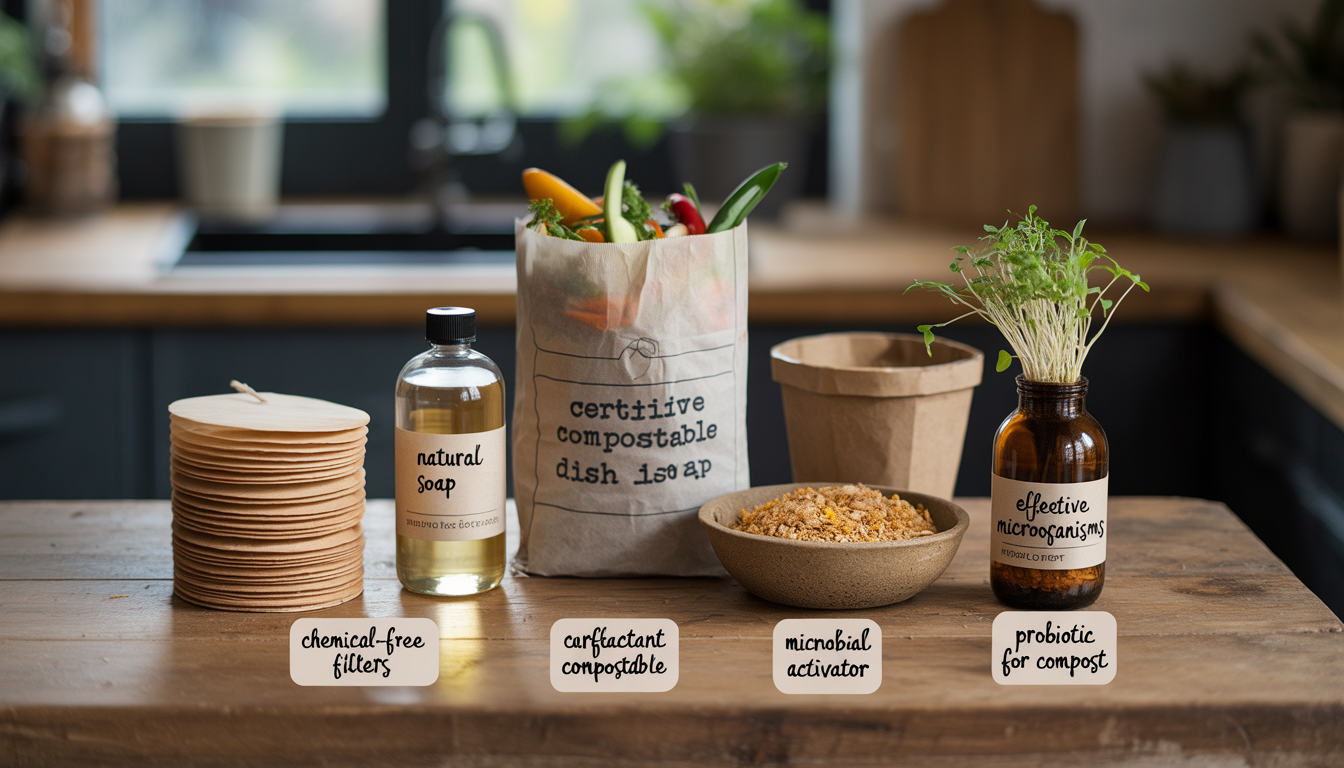
“Unbleached Coffee Filters” > “If You Care” – Unbleached Coffee Filters.🔗 Chlorine-bleached filters leave residues that slow microbial activity. These don’t. Simple swap, real difference. Why I recommend it: It’s the only unbleached filter widely available at this price point.
Natural Dish Soap” > Seventh Generation – Free & Clear🔗 Synthetic surfactants don’t break down cleanly in compost. This one does. Why I recommend it over cheaper options: Your microbes will thank you. Your compost will smell better. Worth the extra dollar. Try stick with “Free and Clear”
“Compostable Bags” > BioBag🔗 – Certified Compostable Not all “compostable” bags are equal. Many contain plastics that don’t break down at home composting temperatures. BioBag is certified for home composting. Why I recommend it: because the certification actually means something.
“Bokashi Bran” > Bokashi Living – Organic Bran🔗 The microbial activator that makes indoor composting possible – even for meat and dairy scraps. Buy from whoever has it in stock locally – it’s the same product.
“EM-1 Microbial Inoculant” > Effective Microorganisms Concentrate🔗 This introduces beneficial microbial diversity into your bin. Think of it as a probiotic for your compost. Is it necessary? No. Does it accelerate everything noticeably? Yes. Skip it if budget is tight – your compost still works.
The Invisible Allies You've Been Ignoring
Here’s what the science tells us about microbial composting:
Clean organic material | Thrives — full decomposition cycle |
Pesticide residue present | Reduced 40-60% |
Synthetic surfactants present | Severely inhibited |
Chlorine bleach residue | Near-complete die-off |
EM-1 inoculant added | Accelerated 30-40% |
This isn’t abstract environmentalism. This is the difference between building living soil and building contaminated mulch.
What You Choose to Buy Becomes What You Return
Here’s the thought the CAVEMAN left us with — and it’s worth sitting with:
“Every peel, every scrap, every drop of soapy water you put in that bin — it came from somewhere. And it’s going somewhere. The question isn’t just ‘what am I consuming?’ The question is ‘what am I returning to the earth?'”
What you eat, what you clean with, what you wipe your hands on — it all returns.
Choosing clean materials isn’t about being a perfect consumer. It’s about understanding that consumption and return are the same cycle.
When you buy an unbleached coffee filter instead of a bleached one, you’re not just making a purchasing decision. You’re making a soil decision. A microbe decision. A food decision — for next season’s vegetables.
Conclusion: You've Noticed What Most People Haven't
Most people compost and never ask what’s in what they’re composting.
You did.
That question — “am I feeding my microbes or killing them?” — is the question that separates a composter from a conscious steward of the cycle.
You now know:
- What to put in and what to keep out
- Why clean materials matter at the microbial level
- Which products actually support the cycle vs. quietly break it
- That your purchasing decisions are ecological decisions
The CAVEMAN didn’t have certifications or affiliate disclosures. He had something simpler: he paid attention.
You’re paying attention now too.
“Everything returned. Everything fed the next season.” — The CAVEMAN, still whispering from the soil beneath your bin.
How to read your compost like a pro — and know exactly when it’s ready to feed the world.
The CAVEMAN will teach you the signs, the smells, the textures — and the moment your invisible allies tell you: “We’re done. Feed the garden.”
Stay tuned.