
Shamanic beats for spiritual cleansing:
Ancient wisdom for modern life
"There's an ache in knowing there's a simpler way."
We live in an age of optimization, productivity, efficiency. We’ve severed ourselves from something ancient, something that knows the world in rhythm and cycles. Shamanic beats offer a return. Not a regression, but a remembering. For thousands of years, across cultures from Siberia to Peru, from Korea to Tibet, rhythmic sound has guided spiritual cleansing and personal transformation. These aren’t exotic practices reserved for remote ceremonies. They’re tools you can use at home, today, to release what doesn’t serve you.
We are not here to sell you a lifestyle. We are here to remind you of one.
This guide shows you what shamanic beats actually do, why they work, and how to practice them whether you’re spending twelve dollars a month on Amazon Music Unlimited or investing in a hand drum. You’ll learn to adapt ancient ceremonies for modern life, build a home practice that fits your schedule, and discover the products that make it accessible.
The journey begins here, in understanding the rhythm your ancestors knew.
What are shamanic beats? Understanding ancient rhythms
Shamanic beats are ritualistic music used in spiritual ceremonies to induce altered states of consciousness and facilitate connection with the spirit realm. But that definition misses something crucial: this is not music as performance. This is music as action.
Wikipedia defines shamanic music as music with “an emphasis on voice and rhythm,” varying across cultures and geographic regions. But in practice, shamanic beats serve a specific purpose. They are the sonic bridge between the everyday world and the world of spirit. They create the conditions for what shamans call “journeying” an intentional movement into altered consciousness where healing, guidance, and transformation occur.
The practice spans millennia. Siberian shamans created layered sound fields with metallic objects attached to their robes. Korean shamans developed highly complex forms, with hourglass drums, flutes, and oboes woven into ceremonial structures. Tibetan practitioners used bell-cymbals (called shang) specifically to clear negative energy before rituals. Peruvian shamans incorporated rhythmic chanting with natural instruments.
What unites these traditions is not the specific instrument, but the intention. Shamanic beats are never mere entertainment. They’re ceremonial actions each rhythm carries purpose, each session aims toward transformation. As Wikipedia notes, shamanic ritual is “a series of actions” rather than simply musical sounds. The shaman’s attention is directed inward, toward visualization and communication with the spirit realm, not outward to entertain listeners.
For modern practitioners, this distinction matters. Shamanic beats are not background music. They’re tools for active inner work.
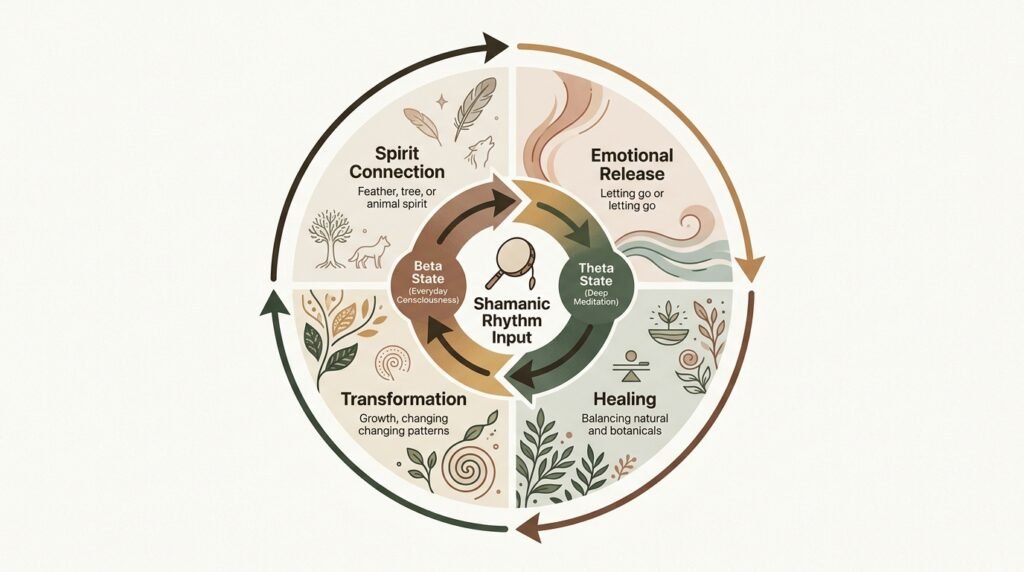
Understand how shamanic rhythm guides your brain from everyday consciousness to deep meditative states, facilitating healing and spiritual connection.
Why shamanic beats work: The science behind spiritual cleansing
When you hear repetitive rhythm, something shifts. Your nervous system begins to synchronize with the beat. Your brainwaves shift from the everyday beta state (alert, thinking, stressed) into theta state the same frequency associated with deep meditation, creativity, and access to the subconscious mind.
According to the benefits documented by Embracing Shamanism, this shift produces measurable effects. The steady rhythm of shamanic drumming synchronizes brainwaves and induces a state of relaxation similar to meditation. Practitioners report stress reduction, enhanced mental clarity, emotional release, and a sense of spiritual connection. But how does this work?
Sound, unlike visual information, is tactile. As Wikipedia explains, “auditory information seems to be both outside and inside the body.” The vibrations of drums penetrate muscle, bone, and nervous system simultaneously. This isn’t metaphorical. The rhythm travels through your body, creating conditions for what neuroscience calls a “trance state” not unconsciousness, but heightened internal awareness paired with decreased external awareness.
Here’s what happens during a shamanic beats session:
Your breath naturally synchronizes with the beat. Your nervous system downregulates, moving from sympathetic (fight-or-flight) to parasympathetic (rest-and-restore) activation. This relaxation opens access to the theta brainwave state, where the boundary between conscious and unconscious softens. Emotions held in the body grief, anger, shame, fear become accessible for release. Many practitioners describe physical sensations: tingling, warmth, involuntary movement. Some experience vivid imagery or emotional catharsis (tears, laughter, deep exhales).
This is what “cleansing” means in shamanic context. It’s not metaphorical. The vibrations and the altered state work together to release what’s stuck energetically, emotionally, neurologically.
The science doesn’t contradict the spirituality. Both describe the same phenomenon from different angles. As shamanic practitioners understand it, you are not separate from nature. You are nature. The rhythm of the drum echoes the rhythm of your heartbeat, the seasons, the earth’s own frequency. Reconnecting with this rhythm, you reconnect with yourself.
Ancient instruments vs. modern alternatives: Choosing your tool
Disclosure: Some links below are affiliate links – I earn a small commission if you purchase, at no extra cost to you. I only recommend products I’ve personally used.
Read our full affiliate disclosure here.
For thousands of years, shamans used what the earth provided: wood, hide, bone, bells, rattles, the human voice. These instruments created the specific frequencies and textures shamanic practice required. And many modern practitioners still use them.
But there’s a modern reality: a traditional shamanic drum costs $500 to $1500. Intensive in-person training costs thousands. A professional shamanic session runs $100 to $150 per hour. For those drawn to this path but constrained by budget or geography, these barriers can feel insurmountable.
This is where modern tools offer an honest service. They don’t replace traditional practice. They democratize access.
Traditional shamanic instruments
According to Wikipedia’s comprehensive overview, shamanic traditions employed specific instruments:
- Shamanic drums: The primary tool across all cultures, played by the shaman to modulate their own state
- Rattles: Used in North American and other traditions to create movement within the sound field
- Bells: Especially in Siberian practice, hung from shamanic robes to create a layered, continuous sound
- Jaw harp (khoums): Common in Tuvan and Mongolian shamanism
- Stringed instruments: In Tuvan practice, instruments made from lightning-struck trees were used specifically for healing
- Voice and chanting: The shaman’s personal song, called “largish” in Tuvan tradition, serves as a unique identifier and source of power
These instruments matter because they carry cultural weight and energetic specificity. They’ve been used for ceremony for generations. Many serious practitioners value this lineage and invest in acquiring authentic instruments.
Modern alternatives for home practice
For those beginning the practice or practicing in modern constraints, several modern tools serve the shamanic beats function:
- Amazon Music Limited shamanic music albums: Pre-recorded drumming created specifically for meditation and spiritual practice. Cost: $12.99/month for unlimited access.
- Frame drums and hand drums: Affordable percussion instruments available through music retailers, ranging $30-150. Lower cost than traditional shamanic drums but offer direct tactile connection to the practice.
- Singing bowls: Tibetan bell-cymbal equivalent, available on Amazon for $25-100. Useful for sound healing and meditation.
- Drum apps and looper software: Digital tools that allow you to create your own rhythm or loop recordings. Minimal cost, full accessibility.
- Body percussion and chanting: Zero cost, maximum intention. Using your voice and hands to create rhythm is equally valid and often deeply personal.
The key insight: intention and consistency matter more than instrument authenticity. A modern practitioner using a $40 frame drum from a music shop with full presence and daily practice will experience as much transformation as someone playing an expensive traditional drum once a month. The rhythm catalyzes the state. The state allows the work.
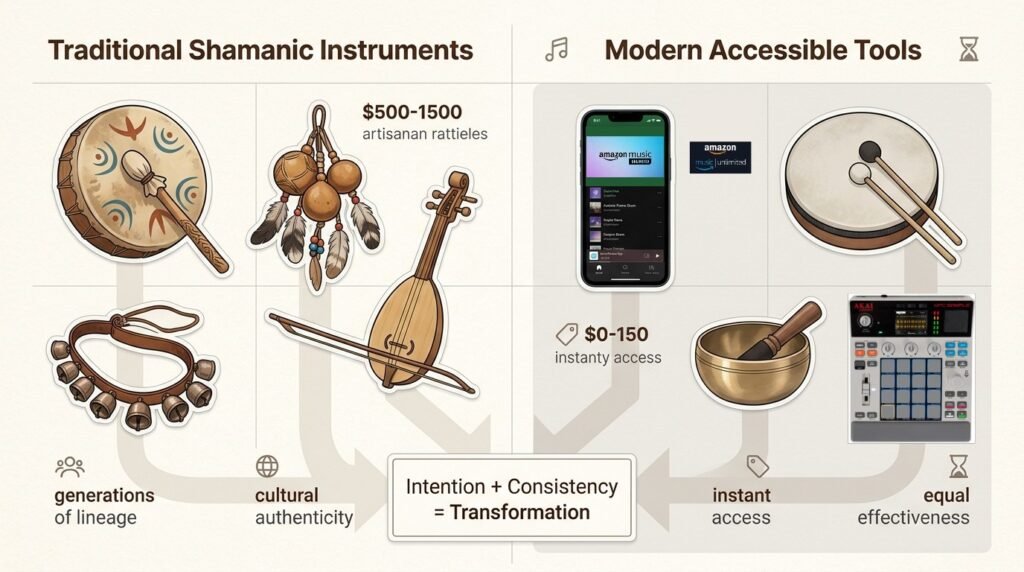
While traditional and modern tools vary in cost and accessibility, consistent practice with either lead to profound transformation.
Comparison: Traditional vs. modern tools
| Tool | Cost Range | Accessibility | Learning Curve | Best For |
|---|---|---|---|---|
| Shamanic drum | $500-1500 | Low (specialty retailers) | Moderate to high | Serious practitioners, ceremony leaders |
| MPC Sample, Drum Machine NEW MODEL 2026 | $399 | Very high (Amazon, retailers) | Moderate to high | Beatbox composers, experimentation |
| Frame drum | $30-150 | High (music shops, online) | Easy | Beginners, daily home practice |
| Singing bowl | $25-100 | High (widely available) | Easy | Sound healing, meditation, solo practice |
| Amazon Music Unlimited shamanic albums | $12.99/mo | Very high (global, instant) | Minimal | Budget-conscious, exploratory practitioners |
| Body percussion + chanting | $0 | Universal | Easy to moderate | Accessible entry, personal expression |
Adapting sacred ceremonies for modern life: Fire and sweat lodge at home
Sweat lodges and fire ceremonies are among the most powerful shamanic practices. They combine heat, darkness, rhythm, intention, and community to create profound transformation. They also require space, safety setup, and often guidance from experienced practitioners.
For those committed to this path, Embracing Shamanism offers formal six-day sweat lodge training. But what if you practice in an apartment? What if you don’t have access to a teacher?
Shamanic beats create a bridge. They can amplify the intention of modern ceremonial adaptations that honor the original practices while fitting contemporary life.
Fire ceremony alternatives
Traditional fire ceremonies use actual flame as a focal point for releasing what no longer serves. The heat, the smoke, the visual element of transformation create powerful symbolic and energetic shifts.
Adapted versions might include:
- Candle gazing ritual with shamanic beats: Light a candle as your fire representation. Play shamanic drumming through a speaker while you gaze at the flame for 15-20 minutes. The rhythm combines with the visual focus to deepen the state. Write down what you’re releasing before the session, then safely burn the paper in the candle flame afterward.
- Palo santo or sage smoke with drumming: Use ethically sourced palo santo or sage (source matters ensure you’re not contributing to over-harvesting of endangered plants). Light it as an intentional purification tool. Play shamanic beats in the background while you move the smoke around your body and space. This combines the traditional smoke element with modern ease.
- Moonlight ceremony: If you live near natural space, step outside during new or full moon with a portable speaker. The moon represents different energies depending on its phase. Play shamanic beats while you sit with lunar light. Many practitioners find moonlight as powerful as firelight.
Sweat lodge alternatives
Sweat lodges work through intense heat, darkness, and group prayer to release physical toxins and emotional blocks. The modern apartment dweller can approximate this:
- Hot bath/sauna with shamanic beats: Fill your bathtub with the hottest water you can safely tolerate. Bring a waterproof speaker and play shamanic drumming. Dim the lights or light candles. Soak for 15-20 minutes, focusing on your breath and intention. When you’re ready, step out and immediately into a cold shower or cold bath (if you have access to a shower). This thermal contrast mimics the sweat lodge’s release mechanism.
- Blanket-tent sweat space: Create a small enclosed space (tent, blanket fort, or even a corner with heavy blankets) where you can sit comfortably. Heat the space if possible (space heater, or simply with multiple blankets). Play shamanic beats quietly. Focus on your breathing and intention. The enclosed space creates psychological and sensory conditions similar to a lodge.
- Group sauna experience: Many cities have public saunas or spa facilities. Bring your own or shared intention. Some modern practitioners coordinate group sauna sessions specifically for this purpose, treating the sauna as a contemporary adaptation of sweat lodge.
The key principle
Shamanic ceremonies aren’t bound to specific tools. They’re bound to specific intentions: to release what’s stuck, to connect with forces larger than the self, to transform. Shamanic beats serve this same intention. When you combine them with a modified ceremony that honors the original practice, you create something real and powerful.
As the Caveman ethos reminds us: You are not separate from nature. You are nature. Your apartment is nature too. The intention you bring is what sanctifies the space.
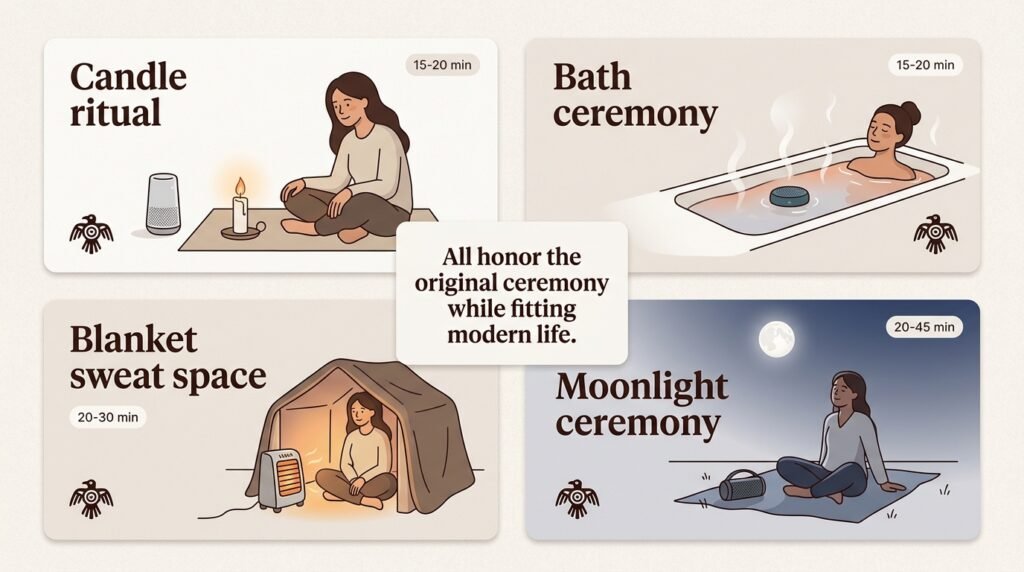
Discover four accessible ways to adopt powerful traditional shamanic ceremonies for your home, even in modern apartments.
A beginner's guide to shamanic beats practice at home
Starting a shamanic beats practice requires no special credentials or certifications. It requires intention, a bit of space, and consistency. Here’s how to begin.
What you'll need
- A quiet space (bedroom corner, living room, yard)
- A drum, speaker with Amazon Music Unlimited access, or app subscription (see next section for options)
- 20-45 minutes uninterrupted
- A clear intention (what energy are you releasing? what are you inviting in?)
- Optional: candle, altar object, journal
Step 1: Set your sacred space
Physical clarity mirrors inner clarity. Remove clutter from your practice space. This isn’t about perfection. It’s about intention. You’re saying to yourself: “This corner is dedicated to my practice. This time is for my work.”
If it feels right, add a simple altar. A stone, a plant, a photo, a symbol that represents your intention. Light a candle. Open a window to bring in fresh air. These small acts shift your nervous system. They signal to your mind: “We’re doing something different now.”
Caveman teaches: Nothing is waste. Everything returns. This space you’ve created is temporary, and it’s sacred. Both are true.
Step 2: Define your intention
Shamanic cleansing isn’t vague spiritual wandering. It’s targeted work. Before you press play, ask yourself: What stuck emotion am I releasing? Grief? Anger? Shame? Fear? Anxiety?
Get specific. Say it aloud or write it down: “I release the grief I’ve been holding about [specific loss]. I invite in peace and acceptance.”
This clarity directs your attention. Without intention, rhythm is just sound. With intention, it becomes medicine.
Step 3: Choose your beat
For beginners, start simple. Look for shamanic drumming at steady tempo (100-120 beats per minute), ideally in 4/4 time. This matches your resting heartbeat and feels naturally grounding.
Options:
- Amazon Music albums: Shamanic Drumming Consort’s “Strong Medicine” offers 10 tracks totaling 33 minutes. Each track runs 3-4 minutes, so you can combine tracks for your desired session length.
- YouTube: Search “shamanic drumming meditation” for free videos from various artists.
- A hand drum: If you have access to a frame drum, playing your own rhythm is powerful and personal.
- Shaker or percussion: Even simple tools create rhythm.
Start with 15-20 minutes for your first sessions. As you get comfortable, you can extend to 45 minutes. Consistency matters more than duration. A daily 15-minute practice beats a weekly 60-minute session.
Step 4: Enter the rhythm
Close your eyes or maintain soft gaze. Let your body feel the beat. Begin matching your breath to the rhythm: inhale for four beats, exhale for four beats. Let your body move if it wants to. Gentle rocking, swaying, subtle shaking. This is not performance. Movement is part of the practice.
Your mind will wander. That’s normal. Your task is not to keep perfect focus. Your task is to keep returning to the breath and the beat when you notice you’ve drifted. This returning is the practice.
You may experience tingling, heat, coolness, involuntary muscle movements. You may cry. You may laugh. You may see colors or patterns. You may feel nothing dramatic and still be doing important work. All of these are valid. The work is happening whether you perceive it or not.
Step 5: Close your ceremony
When your time feels complete (or your timer indicates it’s time), slow the beat gradually. Over two or three minutes, let the rhythm wind down. Come to stillness. Sit in silence for another two to five minutes. This closing is important. It seals the work. It gives your nervous system time to integrate the experience.
Thank the space. Thank the beat. Thank yourself for showing up.
Before you move into your day, journal. What shifted? What surfaced? This record becomes a map of your practice over time. You’ll notice patterns. You’ll track your own unfolding.
Common beginner mistakes
Expecting instant transcendence: Shamanic practice is cumulative. The first session may feel subtle. By session five, you’ll notice shifts in mood, clarity, emotional resilience. Build gradually over weeks, not days.
Stopping too early: The rhythm takes 10-15 minutes to really affect your nervous system. If you only try five minutes, you’re missing the deepest effects. Commit to at least 15 minutes per session.
Overthinking the “right way”: There is no perfect way. Your intuition is your guide. If it feels right to move, move. If you want to chant, chant. The practice is not dogmatic. It’s alive.
Skipping the closing: The closing integrates the work. Without it, you’re leaving the session “open.” Taking five minutes to close properly makes a significant difference in how you feel and what shifts in your daily life.
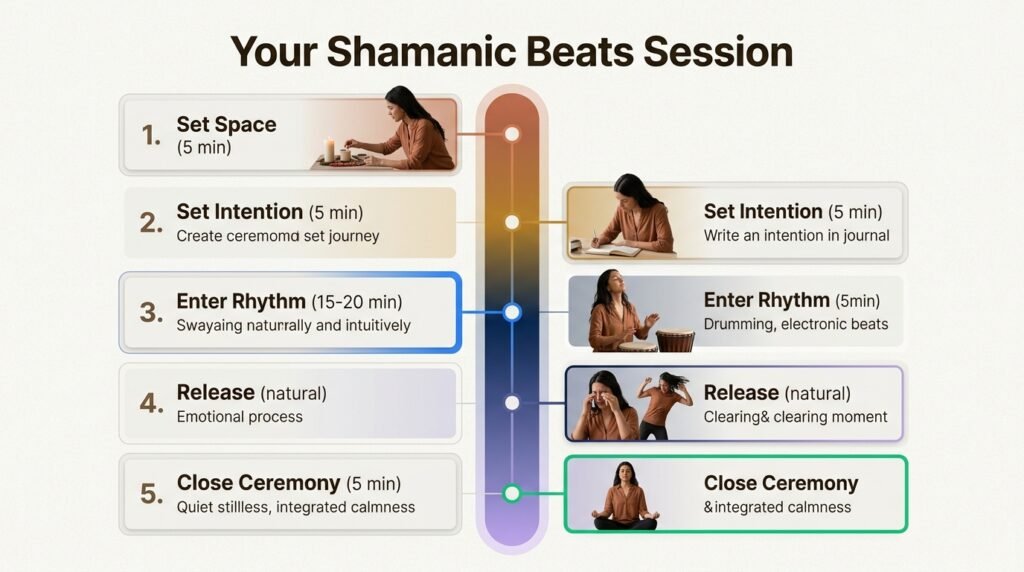
Follow this five-phase to structure to create a complete and transformative shamanic session, from preparation to integration.
Building your shamanic beats collection: Products and resources
Amazon Music Unlimited albums and artists
Note: Most of these are available for high-fidelity streaming via Amazon Music Unlimited ($12.99/month). New signups can often access a 30-Day Free Trial here.
| Album Title | Artist | Year | Purpose |
| Strong Medicine | Shamanic Drumming Consort + Hypnotic Therapy Music Consort | 2024 | Sound meditation, journey, healing |
| Sacred Rhythms: Shamanic Ancient Beats for Modern Healing | Native American Music Consort & collaborators | 2025 | Modern healing applications |
| Shamanic Wolf Ecstasy | Shamanic Drumming Consort | 2022 | Tribal music, transcendental meditation |
| Nordic Shamanism: Viking’s Drums | Shamanic Drumming Consort | 2022 | Norse traditions, drums |
| Shamanic Elixir of Power | Shamanic Drumming Consort | 2022 | Healing drums, fire meditation |
| Prehispanic Rituals | Shamanic Drumming Consort | 2022 | Mayan, Aztec, Inca traditions |
| Banishing Evil Spirits | Shamanic Drumming Consort | 2022 | Protective cleansing, negative energy removal |
Caveman Tip: If you are using the Amazon Music app, look for the “Ultra HD” versions of these tracks. The higher bit-rate captures the true vibration of the drum skins, which is where the real “medicine” is found.
Amazon-available products for your practice
For those wanting direct tactile connection, these items are readily available and represent solid entry points:
Drums and percussion:
- Frame drums (8-14 inches) $30-60. Lightweight, easy to play, portable.
- Shamanic drum $80-150. Usually includes a beater.
- Hand Tongue drums (tongue drums) $40-100. Melodic alternative with easier learning curve.
Sound healing:
- Singing bowl (*Electric Tibetan Singing Bowl) $25-80 (non-electric). Include cushion and mallet. Useful for meditation and sound healing.
- Waterproof Bluetooth speakers (with Lantern Light!) $30-70. Essential if you want to play music albums in bath or outdoor spaces.
Support materials:
- Meditation cushion/zafu $35-80. Sitting support for longer sessions.
- Journaling notebook $10-20. Track your practice and insights.
Cost breakdown for different practice approaches
| Approach | Initial Investment | Monthly Cost | Annual Total |
|---|---|---|---|
| Amazon Music Unlimited only | $0 | $12.99 | $155.88 |
| Amazon Music Unlimited + budget drum ($40) | $40 | $12.99 | $195.88 |
| Amazon Music Unlimited + mid-range drum ($100) | $100 | $12.99 | $255.88 |
| Full setup (drum, singing bowl, cushion) | $250 | $12.99 | $405.88 |
Educational resources
Embracing Shamanism
- Website: embracingshamanism.org
- Training calendar and course options
- Offers everything from weekend introductions to 18-month practitioner programs
- Most comprehensive resource for those wanting formal training and community
Wikipedia: Shamanic Music
- Comprehensive historical and cultural overview
- Free reference for understanding regional variations and traditional practices
- Useful for deepening your knowledge of the cultural roots of the practice
YouTube channels
- Search “shamanic drumming meditation” for free guided sessions
- Many practitioners share recordings of their own practice
- Good for exploring different drum sounds and rhythms without financial commitment
Frequently Asked Questions
Can I use Digital Music beats instead of a real shamanic drum?
Yes. Intention and consistency matter more than instrument authenticity. Amazon Music’s ‘Strong Medicine’ album is specifically designed for shamanic practice. Many modern practitioners start with streaming and upgrade later. What matters is that you’re showing up regularly with clear intention.
How long until I notice changes?
Some people report shifts after a single session. Most experience deeper effects over 2-4 weeks of consistent practice. Think of it like meditation or exercise. The benefits accumulate. You might notice improved mood, better sleep, more emotional resilience, or greater mental clarity.
Is this the same as meditation?
Similar but distinct. Meditation is receptive (you observe); shamanic beats are active (you participate). The rhythm guides your nervous system into specific states. Meditation requires you to find the state yourself. Both are valuable and work well together.
Will this replace therapy?
No. Shamanic beats are complementary, not substitutes. They’re tools for energetic cleansing and spiritual connection, not clinical treatment. If you’re managing trauma, depression, or anxiety, use shamanic practice alongside professional support, not instead of it.
How often should I practice?
Daily is ideal (15-20 minutes). If that’s not realistic, aim for 3-4 times weekly minimum. Consistency builds cumulative effects. A person practicing 15 minutes daily will experience more transformation in one month than someone practicing 60 minutes once a week.
Can I do this with a group?
Absolutely. Shamanic circles amplify collective energy. Many cities have drumming circles (check Meetup or local yoga studios). Online circles also exist. Group practice is powerful. That said, solo practice is equally valid. Both have their place.
What if I don’t ‘feel’ anything during the session?
That’s normal, especially early on. The work is happening neurologically and energetically even if you’re not consciously sensing it. Some people are kinesthetic feelers; others receive subtle shifts in mood or clarity the next day. Keep practicing.
Sensitivity increases over time. Are there any risks?
For most people, no. However, if you have PTSD, epilepsy, or unmanaged mental health conditions, consult a practitioner first. Repetitive rhythm can trigger sensitivities in some cases. Start slowly and pay attention to how your body responds.
What’s the difference between shamanic beats and binaural beats?
Shamanic beats are actual drumming (rhythmic sound with intention). Binaural beats are frequencies designed to affect brainwaves directly. Both work. Shamanic beats are grounded in cultural tradition and active intention-setting. Binaural beats are more passive and technological.
🛒 Ready to Practice With Shamanic Beats?
Grab your instrument- You remind, and connect with your ancestors.