The Ancient Salt Guide:
Wisdom Our Ancestors Knew
(and Modern Cooks Forgot)
"The ocean is made of salt. Your blood is made of salt. Coincidence? Hardly."
Four hundred million years ago, ancient oceans covered the land we now call home. When those waters receded, they left behind mineral deposits that would one day sustain not just life itself, but the very rise of human civilization. Salt wasn’t merely a seasoning to our ancestors. It was survival. Preservation. Currency. Medicine. Sacred offering.
This is the wisdom the Caveman understood instinctively. Long before grocery stores lined shelves with Himalayan pink, French fleur de sel, and Hawaiian black varieties, early humans followed animals to salt licks, traded precious goods for access to mineral springs, and learned that salt could transform perishable harvests into sustenance that lasted through harsh winters.
By the end of this guide, you’ll understand why the “less is more” philosophy isn’t just trendy minimalism, it’s ancestral intelligence. You’ll know exactly which salt to reach for and why. And you’ll discover how this simplest of ingredients can elevate your cooking from forgettable to unforgettable.
Why Salt Is the Original Survival Mineral
Your body doesn’t just want salt. It needs sodium to survive.
Sodium regulates nerve function, fluid balance, and muscle contraction. Without it, your heart couldn’t beat, your neurons couldn’t fire, and your cells would drown in their own fluids. The average adult needs about 500 milligrams of sodium daily just to maintain basic biological functions.
But our ancestors didn’t know any of this biochemistry. What they knew was instinct: salt cravings led them to mineral deposits that kept their tribes alive. Early hunter-gatherers followed deer and buffalo to natural salt licks. Nomadic peoples planned entire migration routes around access to salt sources.
Salt enabled the first food preservation, which enabled the first settlements. Before refrigeration, salt was the only way to store meat through winter, preserve fish for trade, and transform milk into cheese that wouldn’t spoil. The ancient Romans built their Via Salaria (Salt Road) specifically to transport this precious mineral from the Adriatic Sea to Rome.
Here’s a fact that puts salt’s historical value in perspective: Roman soldiers were often paid in salt. The Latin word “sal” gave us “salary.” When we say someone is “worth their salt,” we’re referencing an ancient standard of value.
The Bible mentions salt over 40 times. “You are the salt of the earth” (Matthew 5:13). The “covenant of salt” (2 Chronicles 13:5) represented an unbreakable promise. Lot’s wife was transformed into a pillar of salt for looking back at Sodom. Across cultures and millennia, salt has represented purity, preservation, and permanence.
This is the Caveman philosophy in action: natural rhythms, taking only what is needed, respecting the tools that nature provides. Salt connects us to something older than civilization itself.
The Two Families of Salt (And Why It Matters)
Not all salt is created equal. Understanding the two fundamental families will change how you shop, cook, and taste.
Sea Salt: The Living Ocean
Sea salt comes from evaporated ocean water. It contains trace minerals from the seawater, and because it’s harvested from living ecosystems, it can vary based on location, algae content, and processing methods.
Key sea salt varieties:
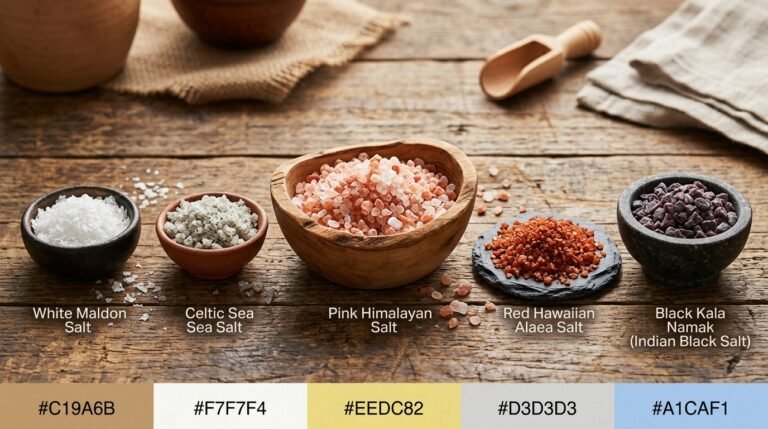
- Fleur de Sel: The “flower of salt” from Guérande, France. Hand-harvested from the surface of evaporation ponds using methods that date to the 9th century. Moist, greyish crystals with a delicate crunch. Source: https://www.seriouseats.com/guide-to-salt
- Sel Gris (Celtic Sea Salt): Harvested from the clay bottoms of the same French ponds as fleur de sel. The grey color comes from clay contact. Higher moisture content (about 13%) gives it an almost soft consistency. Source: https://www.seriouseats.com/guide-to-salt
- Maldon: English flake salt with characteristic pyramid-shaped crystals. Made by evaporating seawater on molds, then flaking apart. Brittle texture that’s excellent for finishing. Source: https://www.maldonsalt.co.uk/our-salt/
- Hawaiian Salt: Alaea (red clay) or Hiwa Kai (activated charcoal) infused sea salt. Traditionally dried in lava beds. The red variety gets its color from volcanic clay rich in iron oxide. Source: https://www.seriouseats.com/guide-to-salt
Rock Salt: The Ancient Ocean
Rock salt comes from underground deposits left behind when ancient seas receded millions of years ago. These deposits formed before industrial pollution, which some consider an advantage.
Key rock salt varieties:
- Himalayan Pink Salt: Mined from the Khewra Salt Mine in Pakistan, the world’s second-largest salt mine. The pink color comes from trace iron oxide (rust). Deposited during the Jurassic era, roughly 200 million years ago. Source: https://en.wikipedia.org/wiki/Khewra_Salt_Mine
- Kosher Salt: Originally developed for koshering meat according to Jewish dietary laws. Large, flaky crystals that dissolve quickly and stick to food surfaces better than table salt. Diamond Crystal and Morton are the two major brands, and they are not interchangeable. Source: https://www.bowlofdelicious.com/salt/
- Kala Namak: Indian black salt that’s actually pinkish-grey when ground. Kiln-fired with charcoal and spices, giving it a distinctive sulfurous, egg-like aroma essential to South Asian cuisine. Source: https://www.seriouseats.com/guide-to-salt
The Mineral Question
You’ve probably seen claims that Himalayan pink salt contains 84 trace minerals and offers health benefits. Here’s what Harvard Health says: the trace minerals exist, but in amounts so small you’d need to consume six times your daily sodium limit to get meaningful benefits. Source: https://www.health.harvard.edu/diet-and-nutrition/the-salts-of-the-earth
The Caveman wisdom? Choose salt based on flavor, texture, and purpose. Not marketing claims.
How to Choose and Use Salt Like an Ancestor
Our ancestors didn’t have measuring spoons. They had intuition developed through generations of observation. Here’s how to develop yours.
Step 1: Understand the Three Purposes of Salt
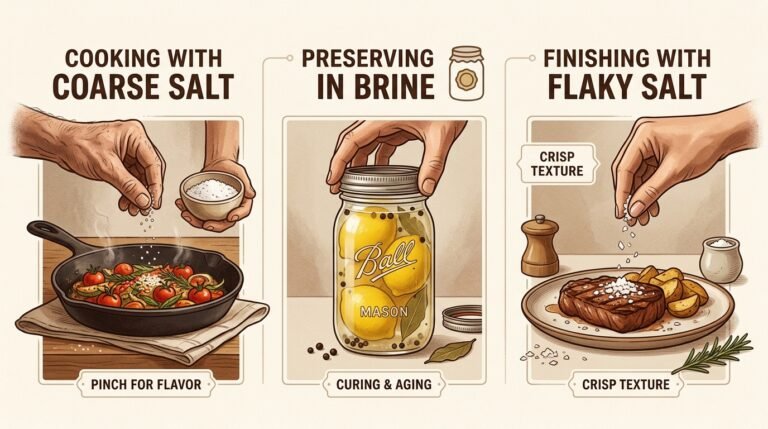
Salt serves three distinct functions in cooking:
- Cooking Enhancement: Seasoning during the cooking process. Salt penetrates food, amplifies natural flavors, and helps proteins retain moisture.
- Preservation: Brining, curing, and fermentation. Salt draws out moisture, inhibits bacterial growth, and creates an environment where beneficial microbes thrive.
- Finishing: Adding at the table or just before serving. Provides texture contrast, visual appeal, and controlled bursts of salinity.
Step 2: Match Salt to Purpose
Different salt shapes serve different purposes:
Salt Type | Best For | Why |
Fine grain (table, fine sea) | Baking, sauces | Dissolves quickly and evenly |
Kosher/coarse | Meat, pasta water, general cooking | Easy to pinch, sticks to surfaces |
Flake (Maldon, Fleur de Sel) | Finishing | Delicate crunch, controlled seasoning |
Coarse rock | Grinding, salt crusts | Fresh flavor, adjustable texture |
Step 3: Learn to Salt by Taste
The Caveman didn’t measure. He tasted, adjusted, tasted again. This is the skill that separates good cooks from great ones.
Here’s the technique: season a small portion, taste immediately, adjust. Your palate will learn faster than any recipe can teach. Different brands of kosher salt have different densities, so if a recipe calls for “1 tablespoon kosher salt,” know that Diamond Crystal and Morton are not interchangeable. Source: https://www.bowlofdelicious.com/salt/
A tablespoon of Morton kosher salt contains nearly twice the sodium of Diamond Crystal because Morton’s crystals are denser. If you’re using Morton in a recipe written for Diamond Crystal, your dish will be significantly saltier.
Tools Worth Having
The right tools make salt easier to use well:
- Salt cellar or pinch bowl: Keep coarse salt within reach while cooking. Pinching gives you better control than shaking.
- Salt mill/grinder: For whole coarse salts. Choose ceramic or plastic mechanisms, never metal. Salt corrodes metal grinders quickly.
- Himalayan salt block: A thick slab that can be heated or chilled. Use it to cook thin proteins (the food picks up subtle seasoning from contact) or to serve cold items like sushi.
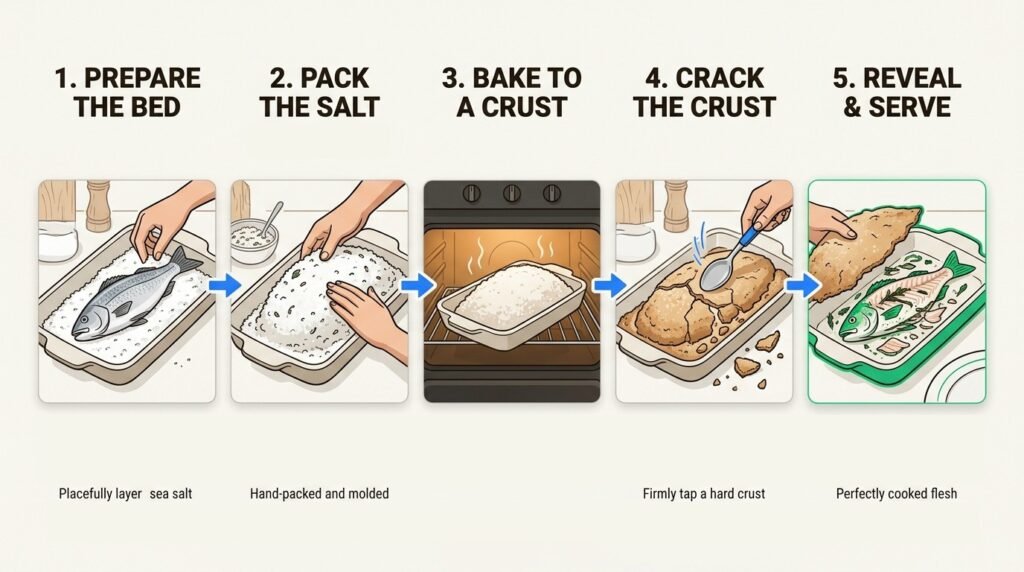
Recipe: Salt-Crusted Whole Fish Roast: The Ancient Preservation Method
This ancient method locks in moisture while seasoning perfectly. It’s dramatic, delicious, and connects you to cooking traditions thousands of years old.
Ingredients
- 1 whole fish (1.5-2 lbs), cleaned and scaled (branzino, sea bass, or snapper work beautifully)
- 6-8 cups coarse sea salt or rock salt
- 4 egg whites
- Fresh herbs (thyme, rosemary, parsley)
- Lemon slices
- Olive oil
Instructions
- Prepare the fish. Pat dry inside and out. Stuff the cavity with herbs and lemon slices. Rub lightly with olive oil.
- Make the salt crust. Mix coarse salt with egg whites until the consistency feels like wet sand. The egg whites help the salt form a hard shell that seals in moisture.
- Encase the fish. Spread a 1-inch layer of salt mixture on a baking sheet. Place the fish on top. Pack the remaining salt mixture completely around and over the fish, ensuring no gaps. The fish should be fully sealed in salt.
- Bake. Roast at 400°F (200°C) for 25-30 minutes for a 2-pound fish. The salt will harden into a solid crust.
- Serve dramatically. Bring the whole salt-encased fish to the table. Crack the crust with the back of a spoon (it will sound like breaking pottery). The salt shell lifts away easily, revealing moist, perfectly seasoned fish beneath. The flesh peels away from the skin effortlessly.
Why This Works
The salt crust creates a miniature oven around the fish. Moisture can’t escape, so the fish steams in its own juices while absorbing just enough salt to season perfectly. The flesh emerges incredibly moist with a subtle, even seasoning throughout.
Sacred Salt: Rituals, Traditions, and Cultural Wisdom
Every thriving culture developed a deep relationship with salt. These traditions contain wisdom worth remembering.
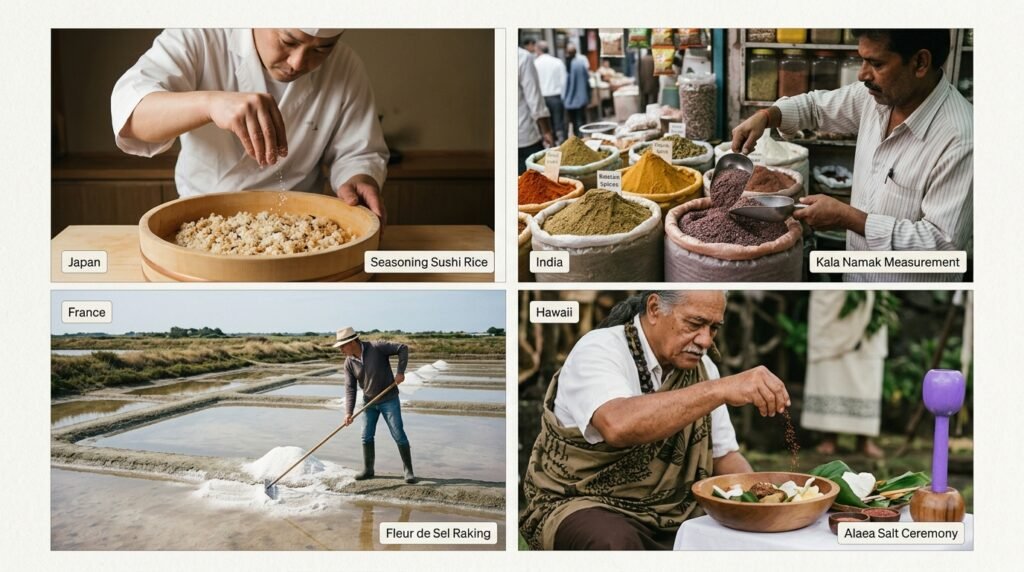
Japanese Shio: Minimalism as Philosophy
Japanese cuisine achieves extraordinary depth with minimal seasoning. A bowl of perfect sushi rice contains only rice, rice vinegar, and a precise amount of salt. The salt doesn’t dominate; it elevates.
This is the Caveman philosophy: take only what is needed. Let ingredients speak for themselves.
Japan’s dietary patterns, which emphasize simple preparations and natural flavors, correlate with the country’s status as having one of the highest life expectancies globally. While many factors contribute to longevity, the Japanese approach to seasoning (using quality salt in moderation rather than masking flavors with heavy sauces) represents ancestral wisdom in action.
Ayurvedic Salt Wisdom
In Ayurveda, the traditional medicine system of India, different salts serve different constitutional types. Kala namak (black salt) is considered cooling and beneficial for digestion. It’s used not just for flavor but for its believed effects on the body’s internal balance.
While modern science hasn’t validated all Ayurvedic claims, the principle resonates: salt is medicine as well as food. The 5,000-year-old Charaka Samhita, a foundational Ayurvedic text, describes specific salt preparations for various ailments.
The French Paludier Tradition
The salt harvesters (paludiers) of Guérande have used the same methods for over a thousand years. They work the salt marshes according to the lunar cycle and weather patterns, harvesting Fleur de Sel only when conditions are perfect. This isn’t nostalgia; it’s recognition that some knowledge can’t be improved upon.
Hawaiian Alaea: Connection to Place
Traditional Hawaiian red salt (alaea) incorporates volcanic clay from specific locations. It was used in ceremonies, blessings, and as medicine. The salt literally contains the land it comes from, a tangible connection to place that mass-produced salt cannot replicate.
The Product Guide: Tools for the Modern Caveman Kitchen
Disclosure: Some links below are affiliate links – I earn a small commission if you purchase, at no extra cost to you. I only recommend products I’ve personally used.
Read our full affiliate disclosure here.
Wisdom first. Then the tools that follow.
Here are the salt products and tools we recommend for building your ancestral kitchen:
Salt Varieties
- Himalayan Pink Salt (Coarse) – Ancient mineral salt from Pakistan’s Khewra Mine. Use in a grinder for fresh, adjustable seasoning at the table.
- Fleur de Sel de Guérande – The “caviar of salts.” Hand-harvested French finishing salt for special dishes. A little goes a long way.
- Maldon Sea Salt Flakes – English pyramid-shaped crystals perfect for finishing. The satisfying crunch transforms simple dishes.
- Celtic Sea Salt (Sel Gris) – Moist, mineral-rich grey salt from Brittany. Excellent for everyday cooking and roasting.
- Diamond Crystal Kosher Salt – The chef’s choice for cooking. Large, airy flakes that are easy to pinch and control. Note: Not interchangeable with Morton kosher salt.
- Kala Namak (Indian Black Salt) – Essential for South Asian cooking and vegan egg replacements. The sulfurous flavor is unmistakable.
- Hawaiian Alaea Red Salt – Volcanic clay-infused sea salt for authentic Hawaiian dishes and beautiful presentation.
- Smoked Sea Salt – Oak or hickory-smoked salt for adding instant depth to grilled meats and vegetables.
Tools
- Salt cellar or pinch bowl – Keep coarse salt within reach while cooking. Pinching gives you better control than shaking.
- Peugeot Salt Mill – Ceramic mechanism (won’t corrode), adjustable grind settings. The gold standard for salt mills.
- Himalayan Salt Block – Use for cooking thin proteins or serving chilled appetizers. A conversation piece that actually works.
Frequently Asked Questions: Your Salt Questions Answered
Q: What’s the difference between sea salt and rock salt?
A: Sea salt comes from evaporated ocean water and contains trace minerals from living seawater. Rock salt comes from ancient underground deposits formed when prehistoric seas receded. Sea salt can vary by location and season; rock salt is consistent because it formed millions of years ago.
Q: Is Himalayan pink salt actually healthier than other salts?
A: Not significantly. While it does contain trace minerals that give it the pink color, the amounts are too small to provide meaningful health benefits. You would need to consume dangerous amounts of sodium to get notable mineral benefits. Choose it for flavor and aesthetics, not health claims.
Source: https://www.health.harvard.edu/diet-and-nutrition/the-salts-of-the-earth
Q: Why do chefs prefer kosher salt for cooking?
A: Two reasons: texture and control. Kosher salt crystals are large and easy to pinch between your fingers, giving you better control over seasoning. They also dissolve quickly and stick to food surfaces better than table salt. Diamond Crystal is the preferred brand among many professionals because its hollow, flaky structure makes it less “salty” by volume than Morton.
Q: Can I substitute table salt for kosher salt in recipes?
A: Only if you adjust the amount. Table salt is much denser than kosher salt. As a general rule, use half as much table salt as kosher salt. Even then, brands vary, so taste and adjust as you go.
Q: What’s the best salt for baking?
A: Fine grain salt that dissolves easily. Table salt, fine sea salt, or fine Himalayan salt all work well. You want salt that will distribute evenly throughout the dough or batter without leaving crunchy pockets.
Q: How much salt should I consume daily?
A: The American Heart Association recommends less than 2,300 milligrams of sodium per day, with an ideal limit of 1,500 milligrams for most adults. The average American consumes about 3,400 milligrams. Most sodium in modern diets comes from processed foods, not the salt shaker.
Source: https://www.health.harvard.edu/diet-and-nutrition/the-salts-of-the-earth
Q: What is Fleur de Sel and why is it so expensive?
A: Fleur de sel (“flower of salt”) is harvested by hand from the surface of salt evaporation ponds in Guérande, France. It forms only under specific weather conditions, requires skilled harvesters using traditional wooden rakes, and yields are small. The delicate crystals dissolve quickly on the tongue, providing a burst of flavor and subtle crunch. Use it as a finishing salt, not for cooking.
Q: Can I use salt for food preservation at home?
A: Yes, but safely. Salt preservation (curing, brining, fermentation) requires understanding proper ratios and safety practices. For beginners, refrigerator pickles and quick brines are safe starting points. For meat curing, follow established recipes precisely, as improper curing can create food safety risks.
Q: What’s Kala Namak and how do I use it?
A: Kala namak is a kiln-fired Indian salt with a distinctive sulfurous, egg-like aroma. It’s essential in South Asian cooking, particularly in chaat masala and raita. Vegan cooks use it to add “eggy” flavor to tofu scrambles. A little goes a long way; start with small amounts and adjust to taste.
Q: Do different salts really taste different?
A: Mostly in texture, not flavor. While trace minerals create subtle differences, most people can’t distinguish between salt varieties in blind taste tests when dissolved. The real difference is texture: flaky salts provide crunch, fine salts disappear completely, and coarse salts offer controlled bursts. Choose based on how you want the salt to interact with your food.
Bring Ancient Wisdom to Your Modern Kitchen
Salt embodies all five pillars of the Caveman philosophy:
- Natural rhythms: Sea salt follows ocean tides and evaporation cycles. Rock salt formed over millions of years. Both connect us to natural processes older than humanity itself.
- Take only what is needed: The best seasoning is often the simplest. Japanese cuisine demonstrates that a single, quality ingredient (salt) can elevate food more effectively than complex blends.
- Community: Salt enabled food preservation, which enabled tribes to store food for others. It was currency, traded between communities. It brought people together around preserved feasts during harsh winters.
- Movement: Salt drove exploration and migration. Ancient peoples traveled vast distances to reach salt sources. Salt routes connected civilizations.
- Respect nature: Traditional harvesting methods (French paludiers, Hawaiian lava beds) work with natural systems rather than against them. They produce superior results with minimal intervention.
The Caveman didn’t have a spice rack with 47 varieties. He had salt, fire, and knowledge passed down through generations. That knowledge told him that the best food comes from respecting simple ingredients and understanding their nature.
Start with good salt. Use it thoughtfully. Taste as you go. The rest will follow.
Explore More Caveman's Meal Wisdom
Ready to continue your journey back to ancestral cooking? Browse our Caveman’s Meal collection for more guides on traditional cooking methods, ancient ingredients, and the wisdom our ancestors knew.
Remember: Wisdom first. Tools that follow.
Sources Referenced:
- https://www.seriouseats.com/guide-to-salt
- https://www.health.harvard.edu/diet-and-nutrition/the-salts-of-the-earth
- https://www.bowlofdelicious.com/salt/
- https://www.eataly.com/us_en/magazine/how-to/a-guide-to-salt
- https://www.maldonsalt.co.uk/our-salt/
- https://en.wikipedia.org/wiki/Khewra_Salt_Mine
- https://www.tilda.com/blog/ingredient-guide/a-guide-to-salt/
- https://www.thechefandthedish.com/post/12-types-of-salt-and-what-they-re-best-used-for
🛒 Ready to Cook Like a Caveman?
Grab your ingredients – Your gut, your taste buds, and your ancestors will thank you.
👉 Shop All Caveman-Approved Salt and Tools
Moonlight Wellness Ritual: ~ The Ancient Secret Your Body Craves